THE MARK
Look for CE and 12312-1
The NHS advises sunglasses with the CE Mark and British Standard 12312-1:2013 E. The College of Optometrists warns counterfeit pairs may not protect properly.
Check a category doodlegearwear.
WHAT THE LABEL SAYS
Sunglasses are kit for your eyes.
A small number on the label tells you how dark the lenses are, and a mark tells you they meet the safety standard. UK guidance says to check both before you buy, and to match the tint to what you will be doing.
Check a category Read the short answer
THE SHORT ANSWER
Three things on or about the label
that UK guidance asks you to check.
THE MARK
The NHS advises sunglasses with the CE Mark and British Standard 12312-1:2013 E. The College of Optometrists warns counterfeit pairs may not protect properly.
Check a categoryTHE NUMBER
Opticians quoted by the AA recommend filter category 2 lenses for daytime driving. Category 4 lenses must be labelled not suitable for driving.
Choosing a pairTHE FIT
The NHS suggests wraparound lenses or wide arms, so light cannot slip in at the sides. Sun reflected off snow and water adds to what reaches your eyes.
See the numbersA QUICK LABEL CHECK
Pick the filter category printed on the label to see how much light the lenses let through and what they suit. The bar shows how dark the lens is.
Based on guidance from the Federation of Manufacturing Opticians, published by the AA. This is general information, not personal eye-care advice.
TWO NUMBERS WORTH KNOWING
One figure on reflected light,
one on why young eyes need more care.
SNOW · WHO
UV reflected by fresh snow
up to 80<small>%</small>
The World Health Organization says fresh snow can reflect up to 80% of incoming UV radiation, which is why skiers and climbers can get snow blindness.
CHILDREN · WHO
UV-A reaching the back of the eye
≈ 20<small>% at birth</small>
WHO says about 1–2% of UV-A passes through to the retina in adults, but around 20% at birth, falling gradually with age. A child's eye is more sensitive.
WHO also notes that squinting and narrowing pupils are triggered by bright visible light, not by UV, and that UV can still be high on a cloudy day.

FOUR CHECKS IN THE SHOP
None of these needs an expensive pair. They are about reading the label and thinking about where you will wear them.
SUNGLASSES AND DRIVING
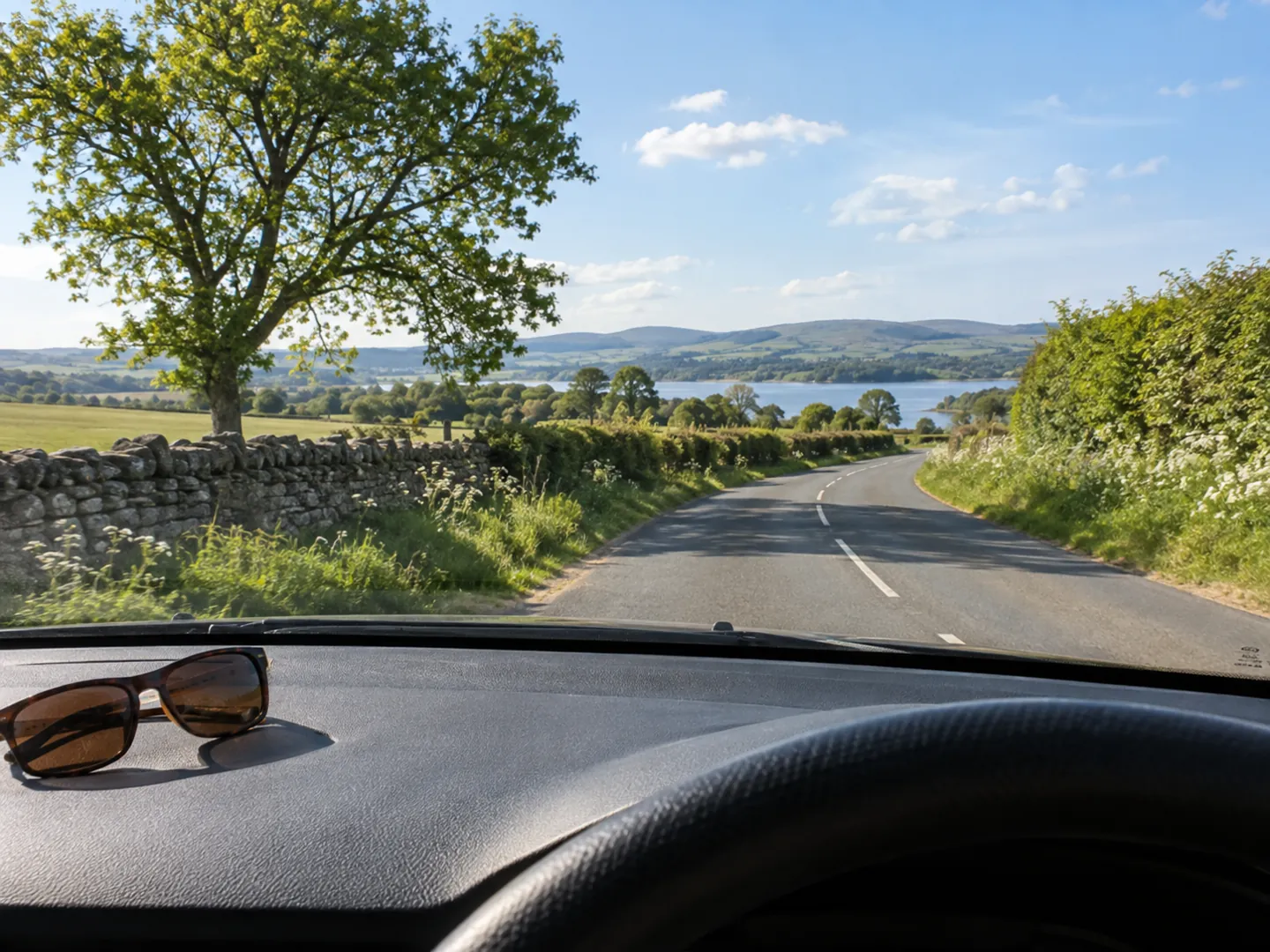
Opticians advising the AA say lenses letting through less than 75% of light are unsuitable for night driving, and yellow tints are not recommended at night either. The Highway Code says not to use tinted glasses, lenses or visors at night or in poor visibility if they restrict your vision.
Photochromic lenses that react only to UV may stay too light in the car, because windscreens filter out UV. Polarised lenses are designed to cut glare and work well on light bouncing off wet roads.
QUESTIONS PEOPLE ASK
It is the filter category, from 0 to 4, showing how much light the lenses let through. Category 0 lets through 80–100% and category 4 only 3–8%, according to opticians' guidance published by the AA.
Filter category 2 lenses, which let through 18–43% of light, are recommended for daytime driving. Category 4 lenses are not suitable for driving at any time, and no tinted lens that restricts your vision should be worn at night.
The NHS advises sunglasses with the CE Mark and British Standard 12312-1:2013 E. The College of Optometrists says the CE mark shows they meet the safety standard BS EN ISO 12312-1.
The College of Optometrists encourages children to wear sunglasses on bright, high UV index days, from a reputable source, while still spending plenty of time outdoors. WHO says a child's eye lets through more UV-A than an adult's.
WHO says UV exposure may still be high on a cloudy day, and the eye's natural defences such as squinting respond to bright light, not to UV. Snow and water add reflected light too.
SOURCES
Each figure on this page comes from the sources below. Check them for the full detail and context.